Information Found in August 2024

Published Sep 1, 2024
Updated Nov 3, 2025
4 minutes read
Note

This old post is translated by AI.

##Information Found

###Science Illustrations

A site that publishes free illustrations of plates, pipettes, and other lab equipment. Note that commercial use requires separate permission.

###If You Haven't Enabled the Force-Quit App Feature from the Taskbar, You Should Turn It On

I really didn't know about this! It's so convenient you should definitely do it!

"Hidden feature" is what it's called, but no complicated steps are required. Just turn on "End Task" on the "Settings" → "System" → "For Developers" page. This feature had been implemented in preview versions before, but it seems to have been officially implemented in recent updates.

###PowerPoint Standard Arrows Not Quite Right!? 5 Techniques to Try Before Searching for Free Materials

How to draw nice arrows in PowerPoint. I learned about it at the beginning of the month and have been using it quite a bit.

###VSCode's GitHub Copilot Has Become More Convenient

###Distribution of Self-Written University Math Introduction Materials - Mai.

Math introduction materials from someone I've been seeing a lot on X lately. You can read the materials for 200 yen on note, and the calculus materials were quite interesting.

I didn't know about ε-N argument at all (sorry to my teacher if I learned it somewhere in my 1st-2nd year of university), so I was able to understand it while watching Koga-san's YouTube. It was very interesting and educational.

###How to Mount USB and Network Drives in WSL

I referenced this because my SSD wasn't being recognized.

sudo mount -t drvfs d: /mnt/d/

###GENIAC Matsuo Lab Competition Ended

I was watching the development process in the Slack community. It was really interesting to see moments like when they pivoted to 8Bx8B, and when they created a spreadsheet system like a self-made chatbot arena for accuracy evaluation.

I haven't looked at the accuracy much, but there are comments saying it feels about GPT-4 level.

From an observer's perspective, the takeaway is that if you spend money properly and train with lots of GPUs, you can create a model with decent accuracy (= LLMs have reproducibility, anyone can make them). "Oh, it really is possible" is the big realization.

As next steps, I hope we can gain know-how on how to create even more accurate models while saving energy and costs, and how to improve security through alignment. I hope organizations emerge with research capabilities that don't lose to OpenAI and Anthropic.

The know-how from this time is generously shared on Zenn, so it's a must-see.

###Machine Learning Notebook

Materials created by Professor Okazaki of Tokyo Tech. Setting aside how incredibly easy to understand it is with interactive graphs, the UI is too beautiful. I didn't know JupyterBook could render this beautifully...?

Looking at the repository below, it seems markdown works too. Nice~

Materials from Yamada-san of Studio Ousia at the DICOMO2024 Symposium in June this year. It covers everything from Transformer basics to the latest model training trends in an easy-to-understand way. I saw Chinchilla scaling laws a lot during GENIAC phase1.

###Large Language Models in Computational Biology – A Primer (2024 Update)
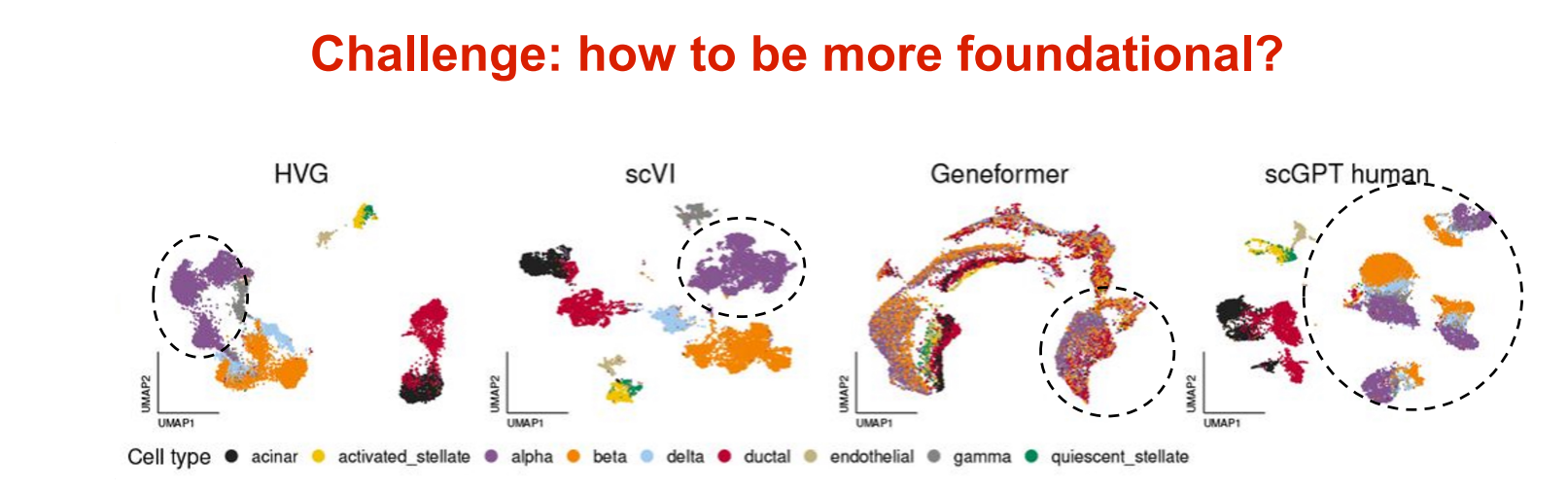
Foundation models in Biology are well summarized. It includes the latest information on single cell foundation models that I've been intensively researching, and information I didn't know was well organized. Very good.

Although trained on millions of cells, current foundation models struggle with different assays in zero-shot settings (Kedzierska et al. bioRxiv 2023). • Pretraining often fails to separate biology from noise and sometimes has no effect (Boiarsky et al. bioRxiv 2023)

This is critical... The road to practical application is long...

###How to Have an LLM Read an Entire Repository's Source Code

An article by Karaage-san from Matsuo Research Institute.

A story about easy RAG using gpt-repository-loader and Dify to understand an entire repository.

The text output contains slightly more prompts than code2prompt which I use, which is nice.

The following text is a Git repository with code. The structure of the text are sections that begin with ----, followed by a single line containing the file path and file name, followed by a variable amount of lines containing the file contents. The text representing the Git repository ends when the symbols --END-- are encounted. Any further text beyond --END-- are meant to be interpreted as instructions using the aforementioned Git repository as context. ----

Also, I hadn't paid much attention to the fact that you can easily create RAG chatbots with Dify, but it looks interesting. I'll try it while watching past LLM study group videos.

###Toketarou

I learned about this site from the Statistics Certification Semi-1st Grade Cheat Sheet.

It explains the knowledge needed around semi-1st grade for beginners from a mathematical perspective, with intuitive essence included. It seems useful to refer to occasionally beyond statistics certification, so I'll visit regularly.

They also seem to be doing YouTube. I wish I had seen this when I was taking the semi-1st grade exam~

I really want to take the semi-1st grade again.

They seem to be selling materials on note.

##Books Read This Month

###Project Hail Mary (Upper and Lower volumes)

A sci-fi novel by Andy Weir, the author of the movie "The Martian." I had been wanting to read it since Horimoto-san praised it highly on Computer Science Radio, and it was on a Kindle sale a while back so I bought it, but I had been leaving it unread until I binge-read it over the weekend.

In conclusion, it was incredibly interesting. This SF is packed with physics, biology, and other stories, and from a biologist's perspective, they're all "quite plausible" stories, which is very interesting. Anything I say about this book would be a spoiler, so I'll just say please read it. Highly recommended for science-loving STEM people. I hope they make a movie soon.

###Sneaky Thinking Through Manga

A book that explains lateral thinking through manga - a "sneaky" way of thinking that doesn't fit in boxes.

At first glance, lateral thinking seems bizarre and even unacceptable in business, but this book explains its effects very clearly.

What was particularly impressive was "there are problems that can't be solved by logical thinking." The idea that no matter how much you rack your brain and think logically, some things just won't work is something that smart people especially should know.

Got it from a Kindle daily deal.

    Footnotes
  1. I really wasn't interested in math... I was just barely able to memorize formulas, and I think I got B's consistently.